Showing posts with label Review. Show all posts

Sunday, March 5, 2023

[Review] Lost Dungeons of Tonsiborg

Received this thing in the mail a couple days ago, purchased as part of the recent Kickstarter. It was originally only offered as a deluxe hardcover "collector's item" edition at $100 per copy, but late in the campaign the organizers bowed to public demand and added an option for a "mass-market" softcover version at $30, which is what I bought. It's POD quality, black & white interior (I believe the hardcover version has interior color), 164 pages long including an index and OGL boilerplate. 

First, some quick history: Greg Svenson was one of the most active players in Dave Arneson's original Blackmoor campaign and, among other things, a participant in the first expedition into the dungeons beneath Castle Blackmoor over the 1970-71 Christmas holiday, as recounted here. In 1973, so after about 2 years of play, Greg decided to create his own dungeon, Tonisborg, using the pre-publication draft of the D&D rules that was floating around the Twin Cities at that time (the first rules these players had ever seen, since prior to Gygax drafting and sending these rules to the Twin Cities for comment, Arneson had kept everything in his head as, effectively, a black box). He then lent the 10-level dungeon to his friend and fellow Blackmoor player (and creator of the Dungeon! boardgame) Dave Megarry, who was spending the summer in Boston, where he promptly lost it. But then, 40 or so years later, Megarry found the manuscript (which it turned out wasn’t actually lost, just misplaced) and shared it with Greg and the guys behind the Secrets of Blackmoor documentary, and they decided to publish it as a book, initially in a super-limited-edition deluxe hardcover collector's edition in 2020, and just now in an affordable paperback version (with promises of an eventual pdf version to come as well).

So this is a pretty neat historical artifact - an actual complete 10-level dungeon (maps and accompanying keys) that dates all the way back to before the publication of D&D, written by one of the players in Arneson's Blackmoor campaign. This makes it very analogous to Rob Kuntz's El Raja Key dungeons, created around the same time by a similarly-situated player (as Rob was one of the most active players in Gary Gygax's Greyhawk campaign) and published a few years back on the El Raja Key DVD Archive, but in an incomplete form (IIRC only 2 or 3 of the 12 levels included keys). This book includes both photographic reproductions of the original hand-drawn maps and hand-written keys (one line per room) as well as re-drawn maps and expanded (but still pretty minimalist) keys in something like the manner of the treatment given to Rob Kuntz's Bottle City.  

Looking at the maps, the resemblance to Arneson's style (as seen in the Temple of the Frog dungeons and the Blackmoor Castle dungeons in First Fantasy Campaign) is immediately obvious, and striking because it doesn't really look like much of anything else that's come out in the 50 years since. The dungeon levels are almost all hallways, many of them at 45-degree angles from each other, with tons of stairways and shafts connecting the levels. Sometimes the hallways meet in larger chambers that are almost always odd-shaped. There are only about a dozen rooms per level (only the bottom level has more than 20 rooms) and they're generally very small (10x10 or 20x20) and hidden behind secret doors in the middle of hallways (sometimes a room will lie at the end of a hallway, but more often the hallways end in stairwells or just dead-end). Almost all of them are occupied by monsters, with seemingly little if any consideration given to the inhabitants' size: a 10x10 room might well contain a dragon or purple worm or 18 ghouls or a dozen giant hogs. My guess as to how this would tend to work in play is that the players would wander down a hallway, a monster would burst out from a secret door to attack, and the party would flee to either a wider hallway or chamber to make a stand, only returning to the monster's lair post-combat to collect whatever treasure it might have had. 

It seems worth noting that all but one of the monsters and three of the treasures (with the "specials" all located on level 10) could be - and presumably were - rolled straight off the tables that would later appear in D&D vol. 2 & 3: a spectre with 10,000 silver, 2 gems, 4 jewelry, and a potion of growth; 2 gargoyles with 6,000 copper and 3 jewelry; 4 giant ants with no treasure; 2 wererats* with 3 gems and a ring of human control, etc. This is primitive stuff. But that's okay. In fact it's the point - it's a window into how the game was played in its earliest days, when it was all novel and everyone hadn't become jaded. Your mind is not going to be blown by this - you're not going to get any mystic revelations into the True Spirit of D&D or whatever. But you might get a stirring memory of the first dungeon you designed when you initially discovered D&D as a kid and how thrilling that was. There's probably no point in actually playing it - anyone with a copy of the rules and a set of dice can come up with something just as good on their own. It might be fun to run at a convention, though - let multiple groups delve in and see which one returns to the surface with the most treasure, and let them know the dungeon they're exploring was created in 1973, before the rules were actually published. Pretty neat for a few hours.

I'm a sucker for D&D history and love looking at these old artifacts - First Fantasy Campaign and Rob Kuntz's archive and those over-the-shoulder photos of Gary Gygax's Greyhawk Castle dungeons, and so on. To me, there's something refreshing ands inspiring about seeing what the game looked like to its creators before it become professionalized - when they were creating stuff to play, not to sell. So, for me, this content, which between the 2 versions of the dungeon and a couple pages of history (the history of the manuscript, not in-game backstory) fills about 50 pages, is worth the $30 I spent on it. Which is good, because the other ~110 pages are weird and dubious.

To start with, before the dungeons, there's a ~35 page introduction made up of essays about how to play and run games in the "old-school" style filled with anecdotes and interview quotes from Arneson and various members of his circle (a lot of it seemingly drawn from Secrets of Blackmoor) a lot of which is good advice (though some of it is questionable) focusing on all of the usual-suspect topics: players should focus on strategy and tactics and think outside the box and focus on the situation rather than the game rules; GMs should focus on keeping things moving and building atmosphere and tension and shouldn't be afraid to improvise (rulings over rules) and shouldn't focus on stuff like balancing encounters - challenges should be tough but potential rewards for good play rich (and resource-management concerns should always be considered: light, encumbrance, etc). Generally pretty solid advice (and, I would note, little if anything that Gary Gygax would've disagreed with) but all very basic and old hat to anyone likely to be reading this book (i.e. hard-core collectors and game-historians). 

Early in this section they make this statement: "We do not assume that you or your players have ever played an RPG before. This entire book is a lesson on how to play these games and how to combine new and old play concepts in order to create an enriching play session." Really? Someone who's never played or read an rpg before is going to pay $100 for this book of all things? This ostensibly high-end collectible (when the publishers were arguing against the notion of doing the mass-market edition one of their justifications was that they wanted it to be an archival-quality collectible that people would treasure and pass on to their grandkids) that isn't even available for sale via traditional retail channels is also supposed to be an entry-level product? Bizarre, to say the least. 

These essays could have made a nice pamphlet aimed at new (or at least new-to-old-school) players, and would sit fairly comfortably alongside the many other such pamphlets that already exist, but in the context of this product it all feels pointless and even vaguely insulting, as if to say that anyone with sufficient knowledge and interest in the history of the hobby to be interested in this book would actually need to learn any of the "lessons" offered here - that we're apparently all idiots who need explained to us (over half a page and at least 500 words) stuff like the idea that the referee shouldn't place the map on the table but should instead describe it to the players verbally and have them draw their own copy of the map as they explore. Wow, really? I had no idea! I mean, I've been doing this for 39 years, but  because I've only experienced the debased Gygaxian version for idiots and not TRV ARNESONIAN DND I've never been exposed to this revolutionary concept. Thanks, guys!

This bizarre confusion about who the audience of this book is supposed to be is compounded by the final third of the book, which is an entire "retroclone" version of the original D&D rules. These "Champions of ZED: Zero Edition Dungeoneering" rules were apparently previously published in a standalone version before being included here and purport to be a true-to-Arneson representation of the game. In practice, it appears to be about 90-95% identical to the contents of the 1974 boxed set, including all of the same ability scores, classes, races, spells, monsters, treasure tables, and magic items, all of which are dutifully reprinted. 

As with any retroclone game, there are a few minor differences: saving throws are handled differently (saving throw values are rolled as a parallel set of stats); XP is only earned for GP that are spent (as per FFC); there's a critical hit system when an attack rolls a natural 20 (with a 1-in-10 chance of instant death); etc. I'm pretty sure all of these differences could have been summarized in about 4 pages of house rulings (and, I should probably note here, none of these additions or changes actually appear to be, you know, any good - to the extent any of them actually do represent material that was used by Arneson and present in the pre-publication drafts but was left out of the published game that's, if anything, a testament to Gygax's editing and playtesting to identify them as bad rules). But instead we get almost 60 pages copy-pasting every spell, monster, and magic item description, and every table from D&D vol. 1 & 2. Curiously, except for a couple pages about dungeon-stocking, nothing else from vol. 3 is included - nothing on outdoor adventuring, castle building, barony management, expert hirelings, aerial combat, or waterborne adventures. Maybe this material was included in the standalone version of Champions of ZED but was excluded here as not being relevant to play within the Tonisborg dungeons? 

We even get half a page explaining how to read dice: what "3d8" means, how to use a six-sided die to get a number from 1-3, and how to use 20-sided dice both to generate a number from 1-20 (use a control die to determine if you use the number rolled or add 10) and to generate a number from 1-100 (roll two dice at once where one represents the tens and the other the ones, with a result of 00 counting as 100, not 0). Because, again, in the publishers’ minds there are apparently people out there who were willing to pay $100 for this book (and, for that matter, to read all the way to page 96 in it) who don't already know that. 

So, it's weird. On the one hand it's a reproduction of an artifact from the earliest days of the hobby of interest to the hardest-core game historians. But on the other, it's trying to be a complete stand-alone game and instruction manual for n00bs (who have $100+ to spare and are following rpg Kickstarters). I'm not sorry I bought it, but am very glad I only spent $30 on the softcover and not $100 on the "collector's item" hardcover. When the pdf version is released, I'd recommend it to anyone who's interested in the early days of the hobby. If you like original D&D and First Fantasy Campaign you'll probably find the middle-third of this book (the actual dungeons) interesting. 

*This one is a mild curiosity because wererats weren't actually included in the original D&D set and were added to the game with Supplement I (Greyhawk) in 1975. I wonder if maybe they were included in the draft Svenson was using but got dropped from the final product, or maybe he'd heard about them from someone who played in Greyhawk, or maybe it was a case of parallel evolution (wererats, after all, feature prominently in Fritz Leiber's The Swords of Lankhmar, published in 1968, and seem like a pretty obvious candidate to become a D&D monster), but the last doesn't actually seem all that likely since it would be the only such case in the dungeon - everything else except for the one "special" monster on level 10 comes straight out of the D&D Vol. 2 monster list  (or, for the various giant animals - spiders, beetles, ants, hogs, etc. - the dungeon encounter tables in Vol. 3)


Wednesday, October 24, 2018

[D&D] [Review] Art & Arcana first impressions


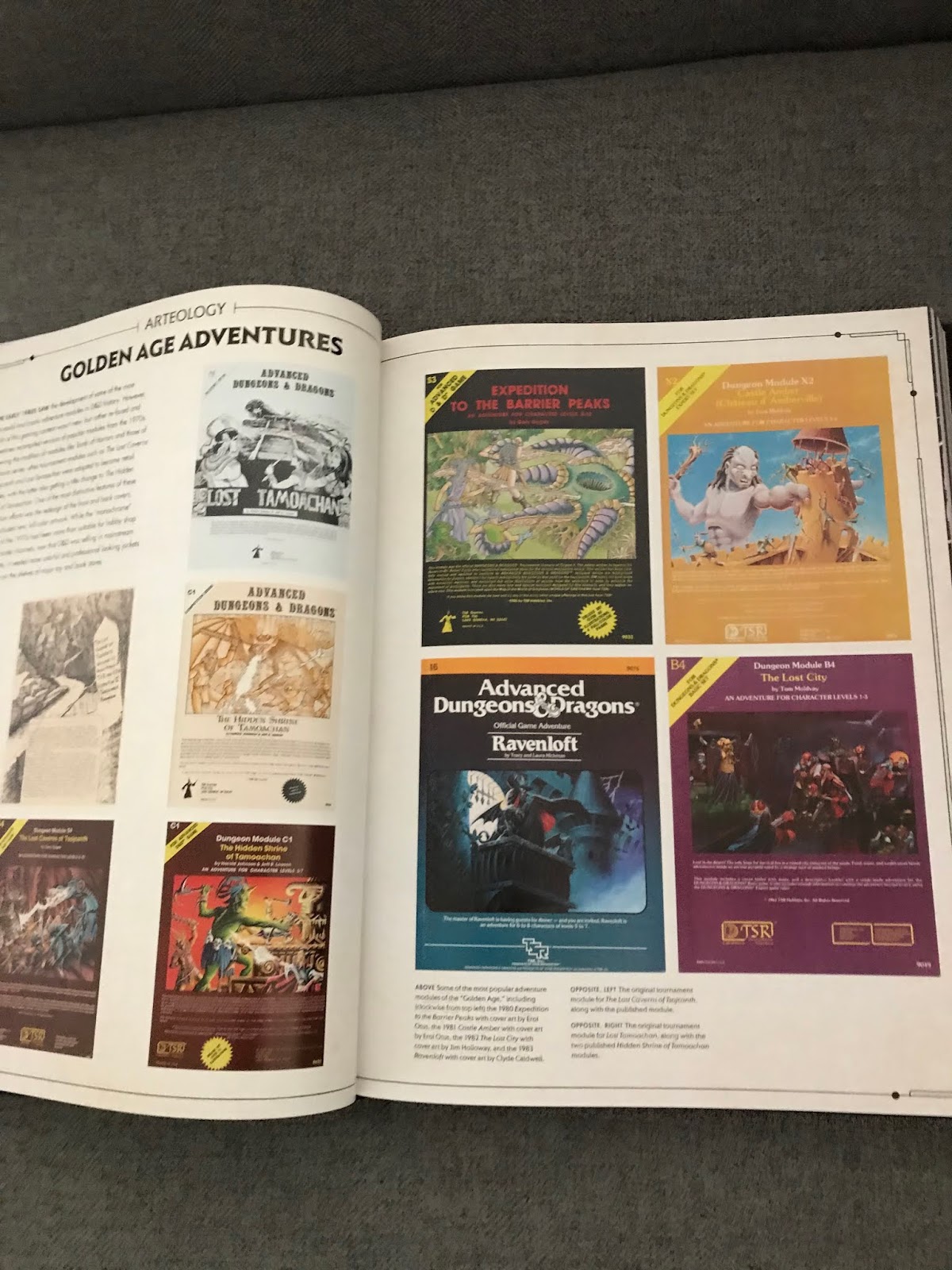
I received my copy of the Dungeons & Dragons Art & Arcana Deluxe Set in the mail yesterday, and while I've only had a few brief minutes to peruse it so far, my first impression is very positive - that this is a substantial and very interesting book that does everything the previous D&D art books (from 1986, 1989, and 2004) did not. While the focus is on the "visual history" of the game, they've taken a much more expansive view of that concept than the previous books, including not only art from the rulebooks and modules, but also extensive discussion and examples of things like logos, trade dress, maps, advertisements, etc.


The book is arranged in chronological order, from the earliest days of Chainmail and the Castle & Crusade Society up through the latest D&D 5th Edition releases, but there are sidebars interspersed throughout - on topics like the evolution of mapping and how different characters and monsters have been depicted throughout the years - that keep the "early edition" content that I'm interested in present throughout pretty much the entire book. I haven't actually read any of the text (aside from some photo captions) yet, but from flipping through the book there is a ton of stuff of historical and nostalgic interest, not just reproductions of art (cover and interior) and old ads and pictures of oddball 80s-era licensed products, but really cool unpublished tidbits as well. Some of this is stuff that people who follow historically-oriented D&D blogs (like Playing at the World) and ebay auctions (like those from  The Collector's Trove) will already have seen - like Gary Gygax's original "Great Kingdom" map that eventually became The World of Greyhawk, and pre-publication versions of some of the famous TSR cover art, but there's also stuff that is new (or at least new to me), such as Gary's hand-drawn maps of the village of Hommlet and the upper works of the Temple of Elemental Evil from his 1976 home campaign, that are intriguingly different from what was later published by TSR (Hommlet is the same but smaller - the "main street" around the Inn of the Welcome Wench is exactly the same, but many of the outlying buildings - the church, the jeweler, the brewer, and the tower - aren't present; while the Temple upper-works are almost completely different). The book is over 400 pages long, and I've only looked through a small portion of it (I confess I got so distracted by studying the TOEE maps that I didn't really look much further after that) so there may well be more surprises of that nature that I haven't spotted yet.

It's worth mentioning that (again, in contrast to the earlier D&D art books) this book is very solidly and well-produced. It is heavy. The paper is thick and glossy and all of the reproductions are very clear - many of them looking better than their original appearances. This feels like something you'd get in a museum store, and justifies its high pricetag.

An even higher price (which, of course, I paid) gets you the "deluxe edition" which includes not only the book with a special matte cover, but comes in a box (with the same cover art) that also includes a pouch of extra swag - loose prints of various key pieces of D&D art through the ages (text-free versions of the cover art of the AD&D Players Handbook and Fiend Folio, Dave Trampier's glorious art from the original AD&D Dungeon Master Screen, and various pieces of later-edition art) that are theoretically suitable for framing, though the larger ones are folded and have visible creases, and most intriguingly a reproduction of the original 1975 tournament version of Gary Gygax's Tomb of Horrors. This is a typescript of a dozen or so pages, a hand-drawn map, and 20 or so illustrations, just like the 1978 module version (but the art is by Tracy Lesch rather than Trampier and Sutherland, so it's of considerably lower quality). The map and at least most of the encounters appear to be the same (though even in a very brief skim-through I spotted at least one or two differences). The summer of 1975 is very early in D&D's history, long before TSR became a professionalized operation, but it's interesting how much of what later became the standard for TSR's modules is already fully formed here - the only real difference between this version and the 1978 version is the production values of the art and map and the typesetting of the text.

And, as a bonus to the bonus, and even more intriguing, the TOH booklet also includes a reproduction of a short dungeon (5 hand-written pages and one map covering 14 rooms) that D&D fan Alan Lucien sent to Gary and that inspired him to create the Tomb of Horrors - the "Tomb of Ra-Hotep." As the name suggests, and which has gone curiously un-commented-on that I've seen in a brief scan of other previews and reviews of this book (and the introduction within the book itself) is that Lucien's dungeon seems to have been a very close and direct inspiration not just for the TOH, but for Gary's later expansion of the same concept as Necropolis: The Tomb of Rahotep. Not only is the villain's name the same, but so is the map and many of the traps and encounters! Lucien was acknowledged with (presumably non-royalty-bearing) "special thanks" in the 1978 TOH module for inspiring its design, which is probably appropriate, since although the idea was similar the specifics are not really. But he curiously was not given any such thanks or credit for Necropolis, even though roughly half of that adventure's tomb section is directly lifted from his dungeon.

The deluxe version costs a lot more than the book version. I don't know that the TOH reproduction, even with the bonus Ra-Hotep content, justifies the price difference, but I'm still glad to have it.

Is this product (either version) worth buying? That really depends on where your primary interest in D&D lies (and, of course, how much disposable income you have). There's little if anything in this book that you will ever use directly in a game - its value is strictly historical and nostalgic and meta. If you're interested in the history and development of D&D you also probably already know most of what's in here and have seen most of the art and maps and ads and ephemera before (and maybe even own most or all of the products). This isn't a utilitarian product by any means - it's a toy, a luxury, a way to feel like you're still connected to the D&D culture even if you haven't purchased a D&D game-book in a quarter-century or more. And, on those terms, it's a winner. It's a very attractive, very well-produced set that will look nice on your coffee table, that you'll have fun perusing, and that might even make some of your non-gaming friends and family more interested in giving this thing a try than they would be from a dry (and, potentially musty) set of vintage rulebooks.

Wednesday, March 21, 2018

[D&D] [Review] The Red Prophet Rises

I don't really do reviews. Mostly that's because I don't really buy new gaming stuff - both because I already have a lifetime supply, and because most of the new stuff I do run across tends to not be very good (or, more charitably, doesn't line up particularly well with my tastes). Nonetheless, occasionally people will give me stuff for free, and that's what happened here: one of the authors of this module (Malrex) reached out and asked if I'd be willing to read it and share my feedback if he gave me a free copy and I said yes. I gave it a quick skim-read, and found it surprisingly not-bad, and shared my thoughts with the author. And since I've already written them down, I figured I might as well post them here as well, as a review of sorts. The first part is background and summary for the benefit of people who aren't the module's author, followed by my reactions and opinions, pretty much directly copied and pasted from what I already sent to Malrex a few days ago.

The Red Prophet Rises, co-written by Malrex and Prince of Nothing, is a 40-ish page AD&D-ish adventure for characters level 3-5, published by The Merciless Merchants and available for $5 in pdf format (or $10 in print) from Drive-Thru RPG. It's a location-based adventure centering around a canyon occupied by a particularly nasty and brutish gang of cultists and a set of caves beneath their lair, of which they're at least mostly unaware, in which assorted ancient horrors dwell. There's a special horse being held captive that can become the mount of a paladin character, which is a possible hook to draw the players into the adventure; otherwise the DM is left to his or her own devices how to use this adventure (making it truly modular). The cultists in the canyon are bad guys to the core, keeping slaves and making regular bloody sacrifices to their Bull God. This is described in a fair amount of gory detail, but it doesn't go totally over the top. The level of gore is probably about on the level of Games Workshop's Warhammer Fantasy Roleplay adventures from the 80s. Which brings up possibly the oddest aspect of this adventure, that it's rather-inexplicably labeled as being for use with the "For Gold & Glory" ruleset which, from what I gather, is an OGL "retro-clone" equivalent to 2nd edition AD&D. This is an odd choice by the authors, because not only did I not notice any particularly 2E-ish elements in the adventure (the NPCs don't have "kits" or "wild magic" or flintlock pistols or any of that stuff, the only specialist wizards are illusionists, etc.) but the tone and style of the adventure is very far from what I think of as "2nd edition AD&D" style: it's dark and bloody, and it's also location-based and open-ended, with minimal backstory and no real "story" except what happens in play. I'm sure the authors had reasons of their own for labeling the book this way, but it seems to me like an odd choice that will probably limit their audience, because people who like the 2E flavor won't like this adventure, and the people who would be more likely to like it probably won't even bother looking at something labeled as crypto-2E. With some very minor changes in the statblocks, this module could just have easily have been released for OSRIC (the 1st edition retro-clone), for which I think it would be a much more natural fit.

And with those preliminaries out of the way, here's what I did (and didn't) like about this adventure based on my skim-reading (I can't claim to have read every word of every encounter, but I feel like I read enough to get a pretty good feel for it):

In general, I like it. I like the set-up with the obvious bad guy cultists on the surface and the more mysterious and weird stuff hidden underneath. That's a pretty standard D&D adventure trope (e.g. Forgotten Temple of Tharizdun) but it's one of my favorites, and the way they've handled it here doesn't just feel like a rehash of earlier work. I like that the villains seems really villainous but without dwelling so much on the gore and cruelty that it feels like they're reveling in or getting off on it. It feels like a situation that could be straight out of a Conan story, which for me is a good thing. I like that the canyon is described in an open-ended manner so there are several different ways the players can approach and deal with it, that there are several flavorful NPCs and potential rival factions, and that there's a suggested timeline of events to make the location seem "alive" (and not just have everybody sitting in their rooms waiting for somebody to come kill them) but that it's not fixed on rails: there are some implicit or potential "scenes" but none of them are fixed or mandatory. I like the way the room descriptions are written and organized, with an introductory paragraph followed by bullet-points enumerating special features and/or possible actions and conditions in a very user-friendly manner that seems like it would work very well at the table - better than when reading. The way the room descriptions include the possibility of different conditions depending on when and how the adventurers encounter them (e.g. that various NPCs and monsters may or may not be present) reminds me a bit of some of my favorite adventures like Dark Tower and Snakepipe Hollow (the latter a RuneQuest adventure).

On the minus side, though, it feels really overwritten to me - like they've taken a situation worth about 20 pages and filled 40 pages with it. The setup feels to me like something that should be a pretty minor adventure - that should fill one or two sessions of play - but the authors have gotten carried away and added too much to it. The adventure details 43 locations, every one of which is described sufficient detail to make it at least potentially a significant and unique encounter. This seems overdone to me: since there are so many rooms and every one of them is something new and different and active there's no real "downtime" - no rising and falling action, but rather it seems like it's "all climax." It feels to me like the authors have crammed too much into the package - that they had so many good ideas and wanted to include all of them - and I think the adventure would've worked just as well (and would probably also be easier to run) if it had about half as many encounters, or at least if there had been more "mundane" stuff mixed in as palate-cleansers to help pace the big moments.

The treasure in the adventure is the same way: all (or almost all) of the treasure is unique magic items with individual names and paragraph-long descriptions of their various functions, most including both benefits and drawbacks for their users. To me this felt like too much, not necessarily the quantity of items as the number of moving parts per item, especially in combination, and especially if the adventure is played as part of a campaign where the players will keep these items and accumulate more on top of them. I know it's conventional wisdom nowadays that generic and from-the-book magic items - +x weapons, etc. - are boring and should be avoided, but in play these things work, because the players get the benefit of them without having to actively think about them, to remember and track all of the moving pieces. Standard magic items are the background against which the unique and colorful items stand out, but when everything is unique and colorful it becomes a burden and frustration, too much to deal with.

Now I get that the authors are in kind of an odd and difficult spot because this is something that they're asking people to pay money for, so they feel the need to give the audience their money's worth in terms of density of fresh and unique stuff that feels like something most readers couldn't have just come up with on their own, and I accept that that's a legitimate concern and that they've maybe handled it in the way they felt was best (make everything special!), but I don't think that necessarily makes for the best adventure to actually sit down and play at the table with a group of friends. If I were to run this in an actual game (and the fact that I'm even thinking in that way means that they've mostly succeeded) I feel like I'd probably end up cutting about half of it out.

Of course I might use something that I cut out of this somewhere else (it's not that I think the encounters are bad, just that there are too many of them; e.g. there are two full pages devoted to a hidden alchemy lab that feel completely excessive to me in this context, but I could totally see this room being inserted into another dungeon where it would fit just fine), and other DMs who feel the same way as I do might choose to cut other encounters than I would (kind of like how everybody agrees that the Beatles' White Album would've been better as a single album but no two fans will ever agree on exactly which songs should have been included on that hypothetical album). Plus we know  that most people who buy this (or any other module) aren't going to actually run it - they're going to dream about it and hopefully draw some inspiration from it and maybe strip-mine some material out of it. So, in that regard, this grousing should be taken with a grain of salt and the authors probably know what they were doing better than my armchair second-guessing gives them credit for. Being in a position that an adventure has too much interesting stuff that you need to trim some of it out to make it manageable to is certainly preferable to the all-too-common alternative of boring adventures that offer nothing that hasn't already been seen a thousand times before or incomplete adventures that the reader/would-be DM has to effectively co-write to turn into something decent and usable.